Let your systems connect.Keep your business flowing.

We connect your applications and data. Edit the JSON, send it to the service and see how its response becomes a working interface.

Let’s connect your systems
API labJSON → API → Interface

Your data.

JSON request body
POST/api/demo/ordersJSON
Edit order names, amounts and threshold⌘ / Ctrl + Enter
Change the priority threshold

Choose an amount, then select Send request. The service returns orders at or above this amount as priority orders.

How do the request and response work?

priorityThreshold sets the priority level. Edit name, total and id within orders, or add and remove orders. The service produces priority flags and summary totals. Amounts must be 0–1,000,000 TRY with up to 2 decimal places. Names are 1–60 characters. Each id is unique and uses 1–16 letters, digits, hyphens or underscores. You can send up to 20 orders.

A response you can see.

From service to interface
No response yet
akışExample app

EVERYTHING IN PLACE

Focus on your orders.

Priority order value₺41,7002 priority orders
All orders06₺66,100
ORDERAMOUNT / PRIORITY
  • Studio collection#1041
    ₺24,900Priority
  • Office selection#1043
    ₺16,800Priority
  • Desk lighting#1042
    ₺7,400Standard
  • Wall lighting#1044
    ₺4,200Standard
  • Living collection#1045
    ₺9,600Standard
  • Accessory set#1046
    ₺3,200Standard
Starting view · example order data

Change an order name or amount, then send the request.

Example service · no data is saved

The right connections. Systems that work together.

You’ve just tried a small data flow. We can bring all your business systems into the same flow.

API and System Integration

Data flows that make your systems work together.

We connect separate applications through APIs and data integrations, defining where information comes from, how it is transformed and where it goes.

Whether you need a new service, less repeated data entry or improved existing connections, we assess source and destination systems together.

What we deliver

A connection needs to keep working correctly.

Data structures and contracts

We define which data will be shared between systems, how fields map to each other and which rules apply. We structure API contracts and data models so changes do not unnecessarily affect other systems.

  • Data mapping
  • API contracts

Service flows

We define how requests are sent, when each system takes part and whether data is transferred synchronously or asynchronously. Authentication, access and communication between services are planned as part of this flow.

  • Service integration
  • Data flow

Error handling and monitoring

We define controlled behavior for connection interruptions, timeouts, failed requests and repeated operations. Logging and monitoring make it clear where problems occur.

  • Failure scenarios
  • Logging & monitoring

The work in context

Data changes. Systems stay in step.

Data from a source must do more than appear in the destination system: it must reach the right field, in the right format and under the right rules. We define field mappings, transformations and validations as part of this flow.

Data mapping
We clearly define which fields represent the same information in different systems.
Traceable transfers
We distinguish successful, pending and failed operations so data movement can be tracked.
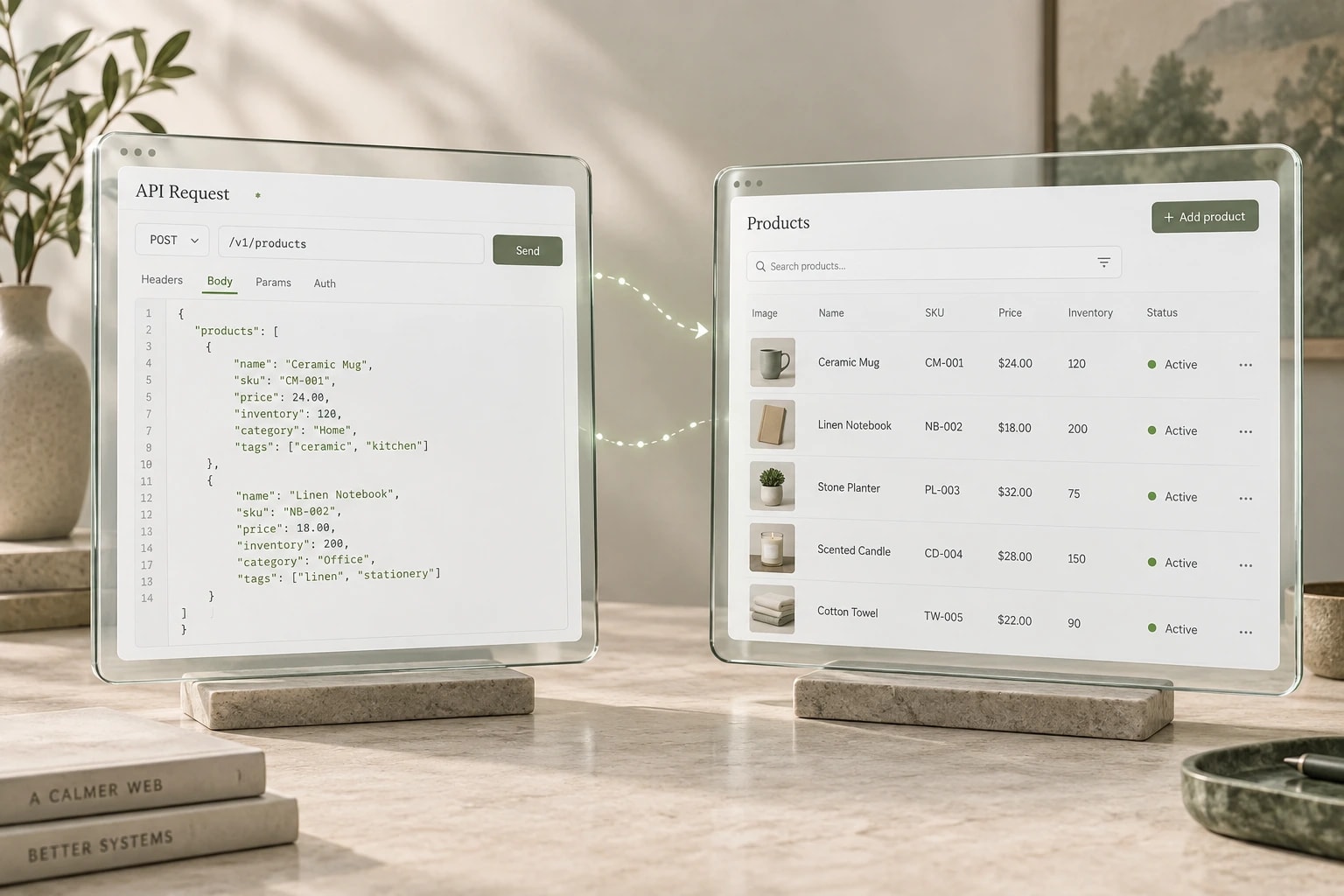
Illustrative integration visual showing the relationship between service data and an application interface.
Illustrative integration presentation; the screens are not client systems.

How we work together

A controlled data flow from source to destination.

We clarify the systems, data movement and possible failures together, building an integration that can be maintained as well as operated.

  1. Understand the systems and data

    We examine API structures, access methods and which data each system is responsible for.

    OutputIntegration scope
  2. Design the data flow

    We define where data comes from, how it is transformed and how it will be used in the destination system. Error handling and retry behavior are also clarified at this stage.

    OutputData flow and API contract
  3. Build the integration

    We develop connections using real data samples and test validation, authorization and boundary conditions.

    OutputTested integration
  4. Deploy and monitor

    We plan the move to production and put error logging, operation tracking and the necessary monitoring in place.

    OutputLive integration and monitoring plan

Engineering in the details

Not every response succeeds or connection persists.

Retries

We account for cases where repeating a request must not create duplicate records.

Versions and changes

We assess how field and service-version changes affect connected applications.

Access boundaries

Required access and secrets are managed at the server boundary.

Common questions

Let's start with your questions.

Can you integrate a system without an API?

The same method does not work for every system. We assess file transfers, database access, export services and other connection methods the system provides. We recommend integration only after a maintainable and secure approach has been established.

What if our existing APIs are insufficient?

We first examine which data and operations the existing services support. Missing capabilities may require new endpoints, intermediary services or data transformation layers. The aim is to establish a reliable connection without unnecessary changes to the existing structure.

Can a connection interruption cause data loss?

Depending on the importance of the flow, we can plan mechanisms such as retries, queuing and error logs. This helps prevent temporary interruptions from turning into data loss; failed operations can be tracked and rerun when necessary.

How often is data synchronized?

This depends on how current the data needs to be. Some flows run in real time, while others run at set intervals or are triggered by events. We build a synchronization model that meets the business need without generating unnecessary traffic.

How do you determine the main data source in an integration?

We define which system is the authoritative source for each data field from the outset. This prevents the same information from having conflicting values across systems and removes uncertainty about which record takes precedence.

How is security handled in integrations?

We plan authentication, authorization, data transfer and access boundaries as part of the connection. The access model is chosen according to the organization's existing security policies and the methods supported by its services.

Will an API change break the existing integration?

API versions and changes are part of an integration's lifecycle. We make critical changes trackable and plan transitions to new versions with as little disruption to existing flows as possible.

Which systems should work together?

Share the source and destination applications, the data to transfer and any API documentation.

Discuss your integration needs