
Problem and data framework
We clarify the decision to support, the goal and the data sources to use. Before modeling begins, we assess data quality, coverage and how well the data represents the problem.
- Problem framework
- Data assessment
We turn your data into useful insights. Explore how demand could change in this small forecasting studio.
Let’s talk about your dataOne product. Changing conditions. New possibilities.
Take a closer look at weekend peaks and missing records.
Explore the forecast.
Good decisions start with understanding the story in your data.
Data and Machine Learning
We start with the business problem to solve, rather than choosing a model. We define which data will be used, how success will be measured and which decision the output will support from the outset.
In forecasting, classification or identifying unusual patterns, the goal is more than producing a result: it must be measurable, understandable and capable of delivering value in real use.
What we deliver
We clarify the decision to support, the goal and the data sources to use. Before modeling begins, we assess data quality, coverage and how well the data represents the problem.
We first establish a baseline for comparison. We evaluate model options using the same data and measures, assessing success through both technical performance and meaningful business outcomes.
We define which system will use the model output, who will use it and which decision it will support. We plan to keep results reliable over time by monitoring changes in data and model performance.
The work in context
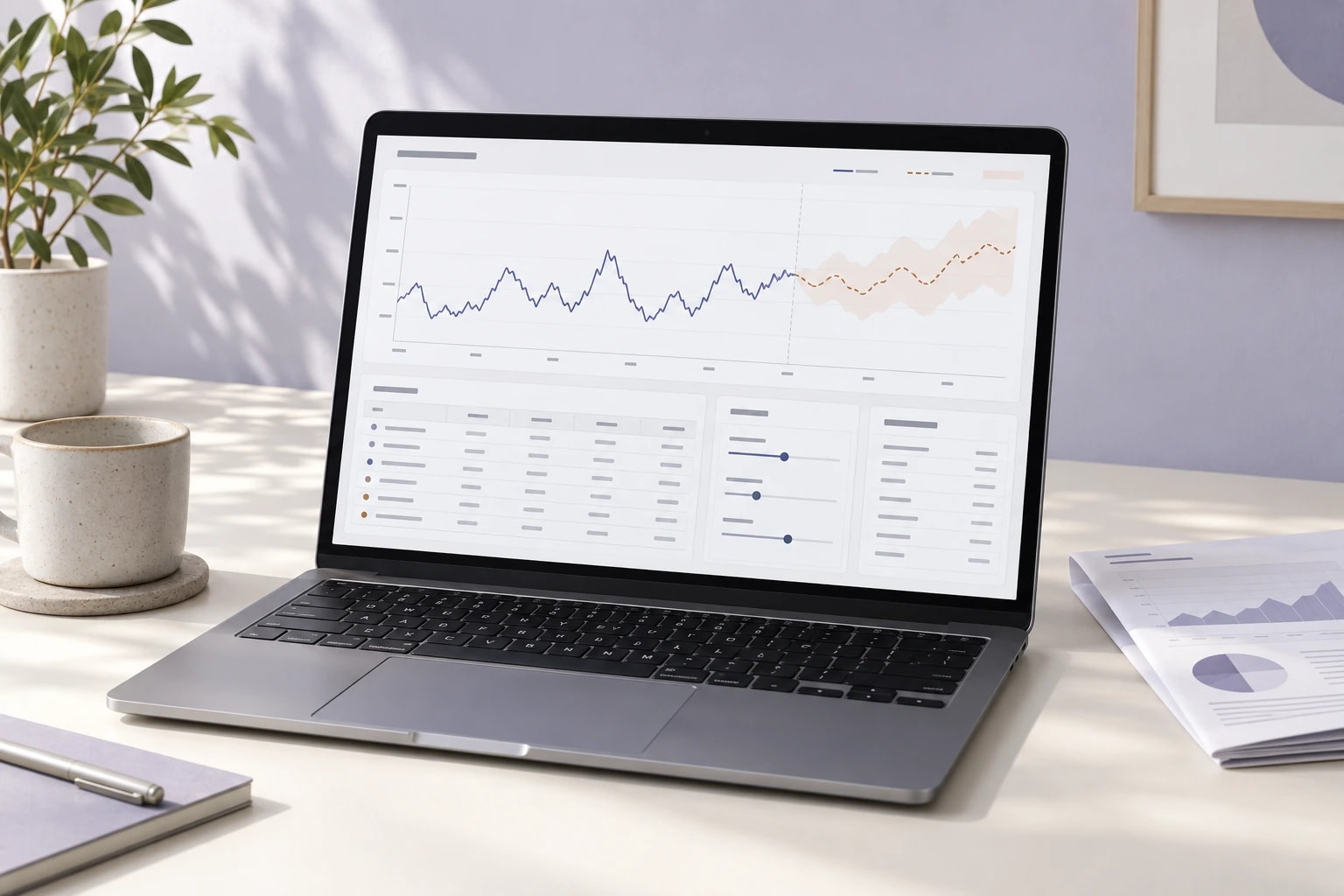
An example demand forecast presents historical observations and future expectations together. Uncertainty and evaluation context matter alongside the predicted value.
How we work together
Deliverables and the working plan are defined around the needs of your project.
We clarify the decision to support, the output expected from the model and the measures used to evaluate success.
We review data sources, quality, coverage and time relationships. We identify gaps and areas that need preparation before modeling.
We compare the baseline approach and model options under the same test design. Alongside performance, we assess explainability, operating cost and alignment with the business goal.
We define which system will use the model output, who will use it and how. Together, we also establish monitoring to track changes in data and model performance.
Engineering in the details
The effect of missing or incorrect records is made explicit.
Evaluation timing and the relationship between training and test data are planned carefully.
Changes in data or usage can trigger the need for reassessment.
Common questions
We first determine which data is actually needed for the decision. Missing information can be addressed by collecting new data, combining sources or narrowing the problem’s scope. Not every need requires building a large dataset from scratch.
We define success measures before developing the model. Alongside technical metrics, we assess the business impact of incorrect predictions, improvement over the existing method and whether the output can actually be used in the decision process.
No. Some problems can be solved more reliably and sustainably through business rules, statistical methods or simpler analysis. We recommend using a model only when it offers a measurable advantage for the problem.
We assess this before developing a model. We examine missing records, duplicates, inconsistencies, time coverage and data fields relevant to the target, clarifying which uses the data can support.
Depending on the use case, we can plan methods that help explain the model’s decision. In decision support processes, we aim to make the main factors influencing the result understandable alongside the score.
Yes. As user behavior, demand, product structure or other conditions change, the data seen by the model can also change. We monitor data distributions and model performance to identify when reassessment or updates are needed.
We define where the output will be used from the outset. Predictions can be integrated through an API, reporting interface, operational tool or existing enterprise systems to reach the point where decisions are made.
Yes, where appropriate. We assess the reliability, freshness, licensing and terms of use of external data sources to determine whether they can be used alongside internal data.
There is no fixed schedule. Retraining needs depend on how quickly the data changes, how frequently the model is used and how performance behaves over time. Some models remain stable for a long time, while others may need more frequent updates.
No. The experience is an illustrative simulation showing how changes in data and scenarios can affect forecasting logic. In a real project, model selection and training are carried out separately using the organization’s data and use case.
Share the business question, available data sources and expected output.