
Knowledge-grounded answers
We prepare documents and available knowledge sources for the use case, designing for visible sources, freshness and limitations.
- Knowledge source structure
- Answers and source presentation
We build AI assistants that understand your notes, plan the work and move with you. Try it with a meeting note.
Let’s adapt it to your businessYour words become a plan that works together.
Describe who needs to do what, and when. We’ll fill in the gaps together.
A prepared output example; no AI is run.
When you run it, your notes are sent to OpenAI for processing. The board stays on this page.
Tasks, owners, dates. Everything your notes turn into will find its place here.
Start with your notes; let’s work out the next step together.
Intelligence that starts with a conversation and carries into your work.
AI Assistants and Agent Development
We develop AI assistants for specific tasks your teams or customers need to complete. Knowledge sources, access boundaries, response behavior and tool use are designed together.
An assistant that answers questions and an agent that acts in other systems need different scopes. Permissions and human oversight follow the use case.
What we deliver
We prepare documents and available knowledge sources for the use case, designing for visible sources, freshness and limitations.
We define which services the assistant can use and when, connecting data retrieval, drafting or initiating a specific action in a controlled way.
We define useful answers and successful tasks through example scenarios, evaluating quality, latency, cost and failure behavior together.
The work in context
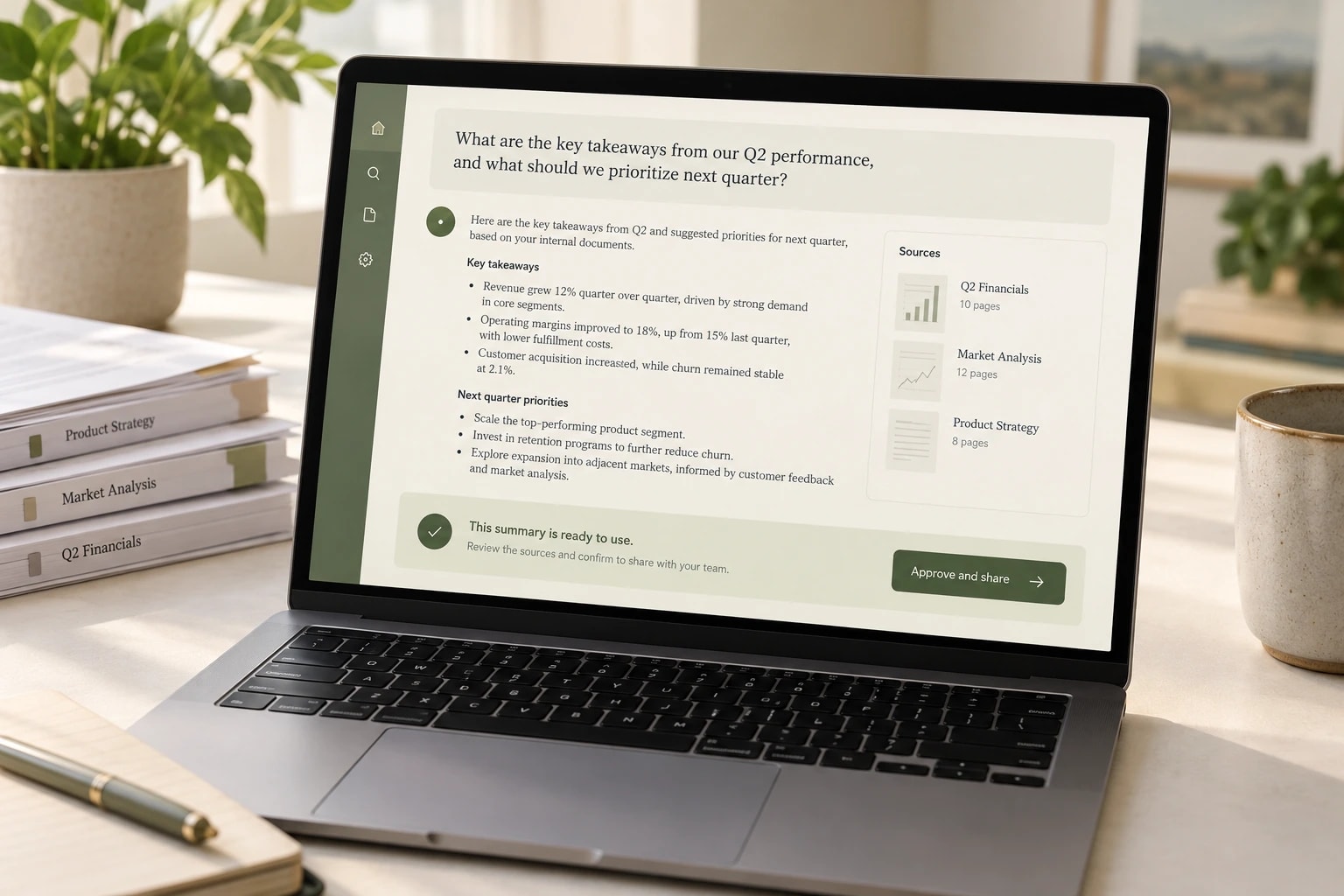
An example knowledge assistant can organize documents around a question and prepare a draft. The information behind the answer remains visible; the user stays in control of steps that involve sharing or taking action.
How we work together
We define the assistant’s purpose, knowledge sources and scope of action from the start, then validate it with real scenarios before putting it into use.
We clarify who the assistant serves, what it should do and where it should stop. We also define how success will be measured at this stage.
We determine which knowledge sources it can access, which tools it can use and which actions require user approval.
We evaluate the assistant’s responses and actions with real questions, tasks and edge cases. Incorrect, uncertain or risky behavior is identified before live use.
We complete the interface, monitoring mechanisms and human approval where needed, then launch with a structure that supports measurement and improvement.
Engineering in the details
We define the sources the assistant can access in line with user roles and existing permissions. When generating answers, it can retrieve only authorized information.
We design the assistant to state clearly when information is insufficient or an answer cannot be verified, request more information where needed or direct the user to the right source.
We clarify the boundary between providing information and taking action in systems. For critical steps or actions that are difficult to reverse, user approval becomes part of the process.
Common questions
We define its knowledge sources, access permissions and the purpose of data use within the project scope. We design a structure that preserves existing user permissions and accesses only the necessary information. Model and infrastructure choices are evaluated alongside the organization’s security and data requirements.
No. We distinguish low-risk tasks such as summarizing, searching or drafting from actions such as changing records, sending content or initiating operations in other systems. Approval points are determined by the risk of the action.
We design the assistant to manage uncertainty as well as produce answers. We define scenarios in which it should state that sources are insufficient, ask for more information or hand the action over to the user.
One model may not suit every use case. We evaluate answer quality, speed, cost, context needs, tool use and the organization’s security requirements together to determine a suitable model and infrastructure approach.
When suitable access and services are available, connections can be built with CRM systems, document sources, enterprise applications or internal services. We define both which systems the assistant connects to and which actions it can perform in them under which conditions.
We do not judge success solely by whether an answer appears correct. We define measures such as accuracy, source use, task completion, latency, failure behavior and transitions to human support according to the use case.
Depending on the need, sources used, tool calls, approvals and critical actions can be logged. This makes it possible to review what the assistant did and which information it relied on.
Share the users, the knowledge they need and the output you expect.